Search at Frontify
Designing a scalable, trustworthy search system for a complex brand management platform serving 1 million monthly active users.
I led the design of Search at Frontify, a brand management platform serving 1M+ monthly active users. As the platform grew in content volume, scope, and intelligence, search became a critical system — not just for findability, but for user confidence, predictability, and trust.
The challenge was not only to help users find content faster, but to ensure they understood where results came from, why they appeared, and how much control they had in an increasingly powerful system.
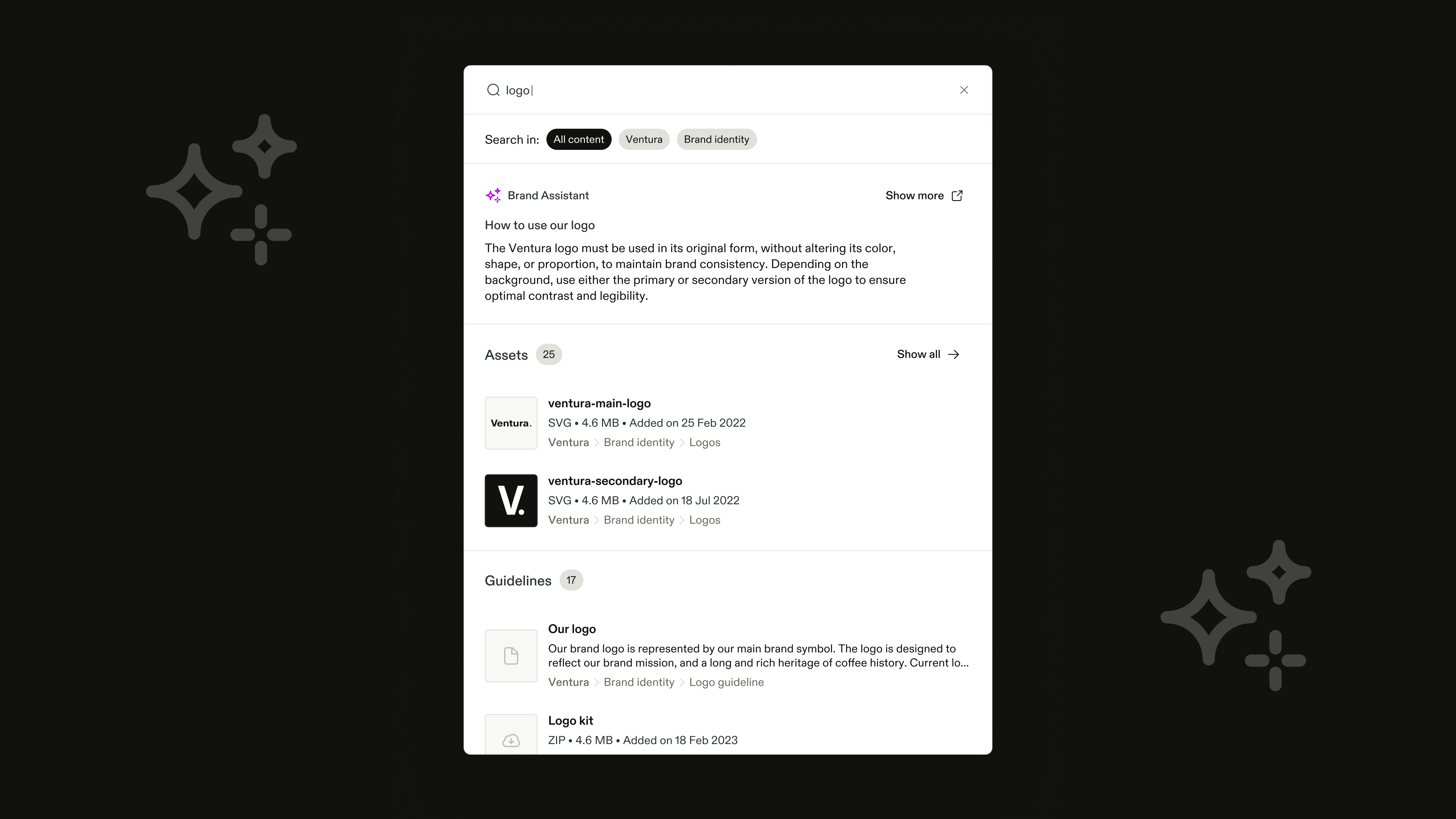
Background
Research showed that search served two distinct but equally important needs:
This meant search had to support both exploration and efficiency without becoming overwhelming or opaque.
-
Nearly half of users relied on search when they didn’t know where content lived
-
The other half used search as a faster navigation shortcut
This meant search had to support both exploration and efficiency without becoming overwhelming or opaque.

Search before redesign
The UX challenge
Before the redesign, search was already showing signs of a classic agentic problem:
At this point, the core risk wasn’t usability alone — it was users no longer trusting search as a reliable decision partner.
-
As content types increased (assets, guidelines, text), users lost clarity about scope
-
Separate contextual searches fragmented the experience and created uncertainty
-
Exact-match logic and incomplete indexing reduced trust in results
-
More “power” didn’t translate into more confidence: users often stopped engaging after the first results
At this point, the core risk wasn’t usability alone — it was users no longer trusting search as a reliable decision partner.
My role
I led this work end to end as Design Group Lead, owning:
-
problem framing and research direction
-
interaction and system-level design
-
key UX decisions across Product, Engineering, and Research
Beyond designing screens, I was responsible for how decisions were made, validated, and scaled across teams.
Key design decisions
︎ Unifying search to preserve mental models
Problem
Multiple contextual searches (assets vs text-based content) forced users to guess where to search before even starting.
Options considered
-
Keep contextual searches and improve labeling
-
Fully merge all searches into one global experience
-
Introduce a unified entry point with clear scope behavior
Decision
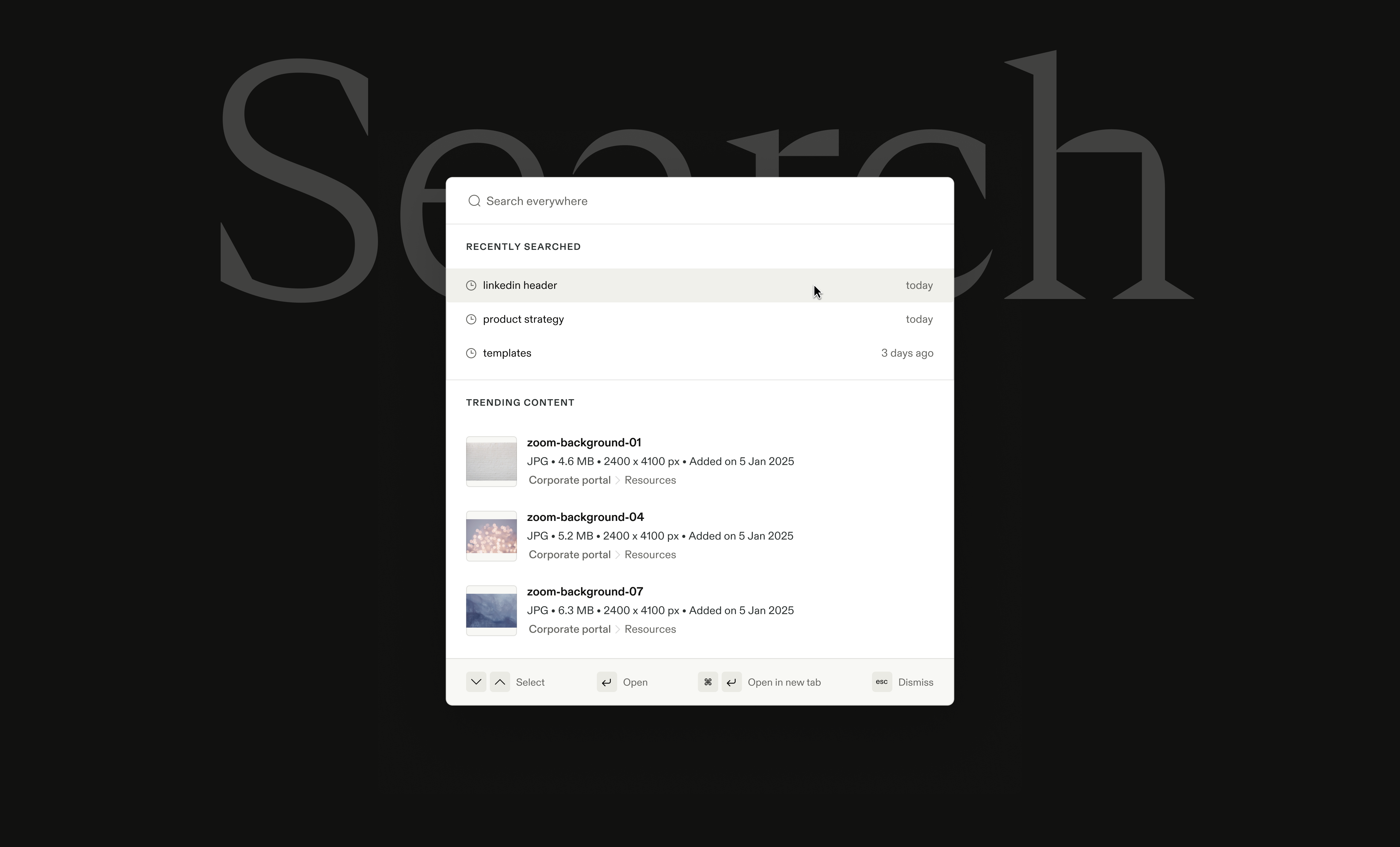
I introduced a unified command-style search, accessible globally via keyboard shortcut or UI entry points.
Why
A single entry point reduced cognitive load and preserved a clear mental model: “Search starts here.”
Scope complexity was handled by the system, not pushed onto the user.
︎ Prioritizing transparency over “smart but invisible” behavior
Problem
As indexing expanded, the system could technically surface more results — but users struggled to understand why certain results appeared or were missing.
Decision
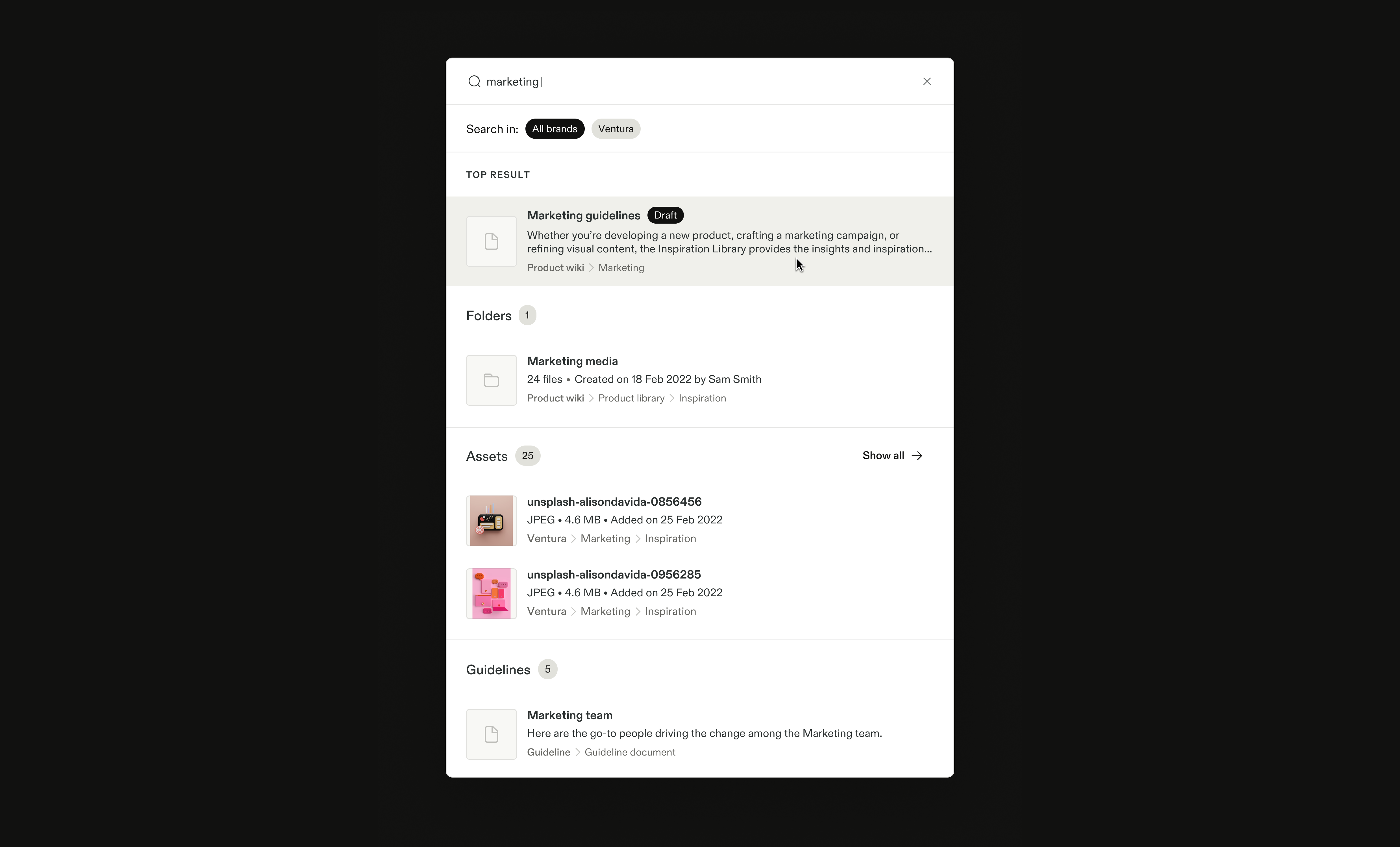
We expanded indexing across all content types while ensuring:
-
predictable ranking behavior
-
clear result labeling
-
consistent interaction patterns across content types
Why
We deliberately avoided overly “magical” automation. The goal was confidence and learnability, not surprise.
︎ Designing for discovery without taking control away
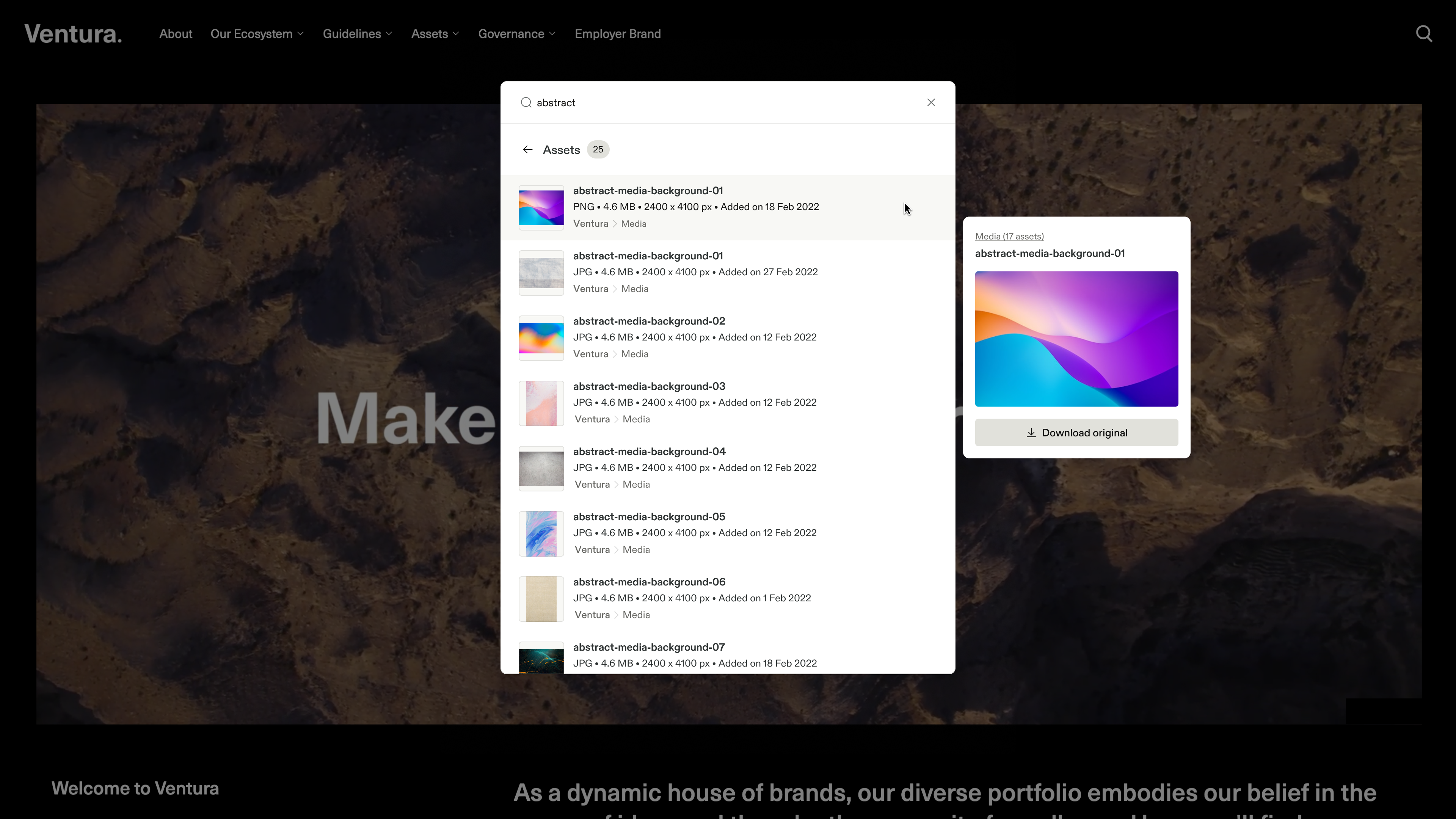
Research revealed that many users were unaware when editors added or updated content.
Decision
Search was designed to surface new and relevant content intentionally, turning it into a discovery tool — without auto-navigating or interrupting user intent.
Why
This positioned search as a collaborative assistant rather than an autonomous agent, maintaining user agency while increasing engagement.
Accessibility as a system requirement
Search was fully designed for keyboard navigation and tested against accessibility standards with external validation.
Accessibility was treated as a first-class system constraint, not a later enhancement, and was developed in close collaboration with Engineering and Research.
Impact
-
+10% increase in search engagement, driven by improved trust and clarity
-
Higher task completion and deeper result interaction
-
Reduced confusion between content types and scopes
- Search evolved from a utility feature into a core, trusted workflow entry point.
Outcomes
This work resulted not just in a redesigned feature, but in:
-
a set of interaction principles and patterns for search
-
shared decision frameworks across teams
-
a foundation that safely supports future AI-powered and agentic capabilities.
These patterns are now reused across search and AI-related experiences at Frontify.
© Anna Lukyanchenko 2025 — all rights reserved